One operational layer for healthcare
MedOS connects the operational parts of your healthcare business into one flexible platform. Scheduling, inbound documents, forms, billing and claiming, automation, integrations and reporting — around the clinical systems you already run.
MedOS connects the operational layer of healthcare
MedOS sits across your healthcare operation — connecting the tools you already use, removing manual steps, and giving teams the workflows they need without forcing a full system replacement.
Modular, configurable and designed to grow with your organisation.

Connect
Connect existing systems, referrals, documents, staff, patients and billing workflows.
Automate
Trigger actions, communications, tasks and workflows based on real operational events.
Configure
Build forms, templates, workflows and modules without complex development.
Measure
Track performance, workload, billing, patient flow, compliance and operational KPIs.
The smartest medical calendar
Scheduling built for real clinical operations — clinicians, sites, rooms and devices, recurring treatment plans, blocked theatre time, buffers and opening hours. The calendar that actually understands healthcare.
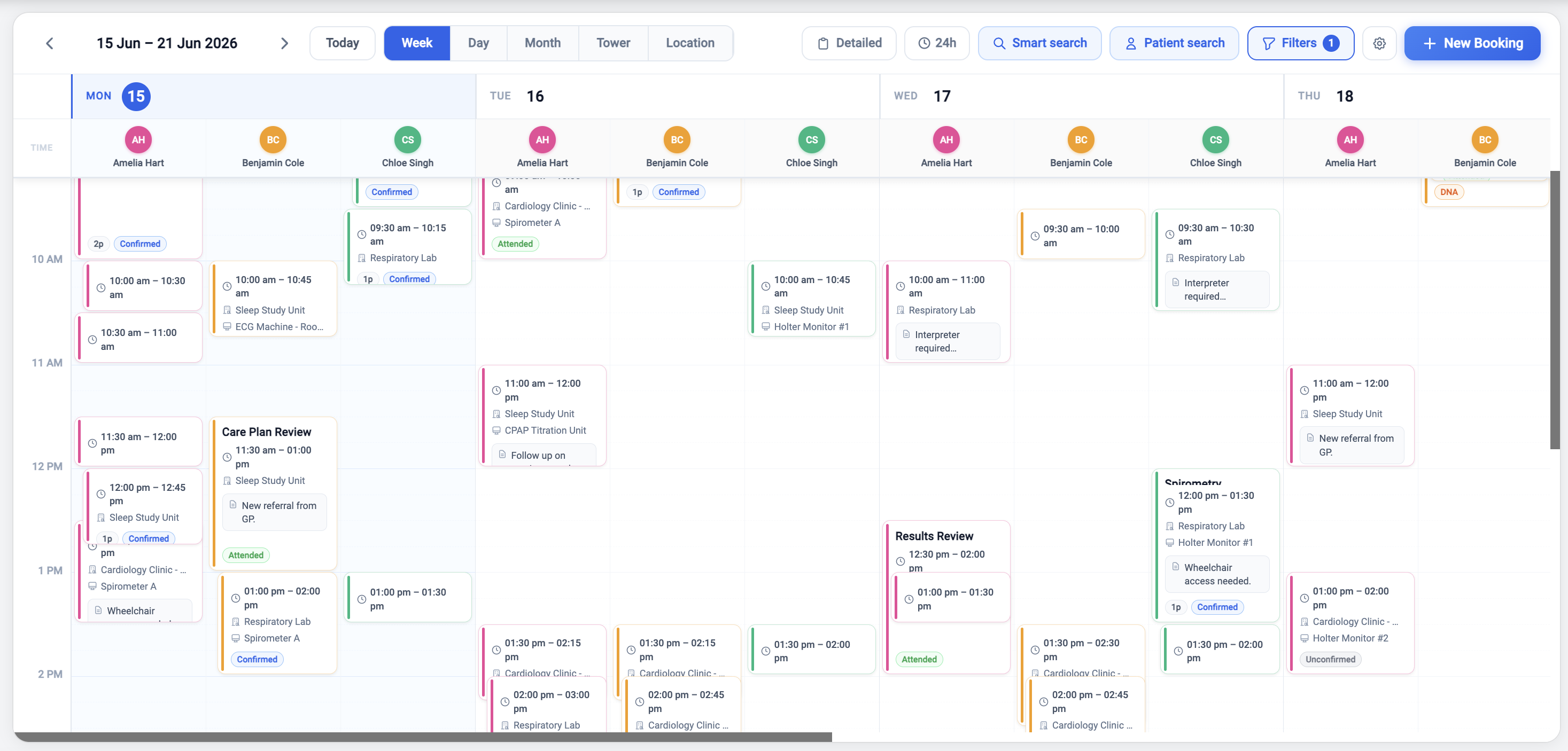
Clinicians ⇄ locations
One toggle re-columns day, week and month by who is working or where the work happens, and recolours to match.
Recurring series
Daily, weekly on chosen days, or monthly — ending after N or on a date. Clashes are skipped and reported, and edits apply to this event, this and following, or all.
Blocked time
Theatre lists, leave and maintenance hatch out the grid. Bookings that overlap a block are refused, not warned about.
Buffers
Prep and clean-down time before and after a booking, shown on the grid and counted in device conflict checks.
Facility hours
Each site keeps its own weekly opening hours; out-of-hours time is shaded and booking into it asks first.
Devices and rooms
Scanners, labs, chairs and theatres are bookable resources with their own conflict rules.
Categories that carry defaults
Choosing a booking category fills the title and sets the appointment length your practice actually uses.
Saved views
Filter by clinician, location, category, device or status — then save the view your team opens every morning.
Public holidays
Import the holiday calendar once; week and month mark them for everyone.
Every referral and result arrives in one place
Medical Objects, e-fax, email and the scanner all land in the same triage queue — classified, matched to a patient, assigned, actioned and audited. The clinical front door, finally in one piece.
Referral — chest pain, urgent
Dr Priya Raman · Northside GP
Medical ObjectsReferralPatient linkedFBC, UEC, LFT results
Melbourne Pathology
Medical ObjectsPathology resultPatient linkedScanned request form (2 pages)
+61 3 9xxx xxxx
E-faxReferralNeeds patient matchDischarge summary — 14 Aug
St Vincent's Hospital
E-faxDischarge summaryPatient linkedConsent form returned
reception@clinic.com.au
EmailConsent formPatient linked
Channels in
Medical Objects
Australian secure clinical messaging — referrals, specialist letters and results delivered straight into triage, with the raw message kept intact.
E-fax
The referral channel nobody has managed to switch off yet. Connect your fax provider and inbound faxes arrive as classified documents, not paper.
Monitored clinical mailboxes, with attachments split out and typed on arrival.
Scan & upload
Front-desk scanning and drag-and-drop for whatever walks in the door, filed the same way as everything else.
API
Push documents in from any system you already run, through the same envelope every other channel uses.
Matched, not guessed
MedOS proposes the patient from the message demographics. A confident match links itself; anything else waits in Needs patient match for a human. You can create the patient from the document in one step.
Linked to real work
Attach the document to a procedure, raise the booking, assign it to a person or a team, tag it, escalate it or file it — from the same screen you read it in.
Nothing lost, everything logged
The raw HL7 or original file is preserved untouched alongside the extracted data, and every action on a message is written to an audit trail.
Classified on arrival
Australian claiming, handled properly
Medicare, ECLIPSE, DVA, WorkCover and TAC are not a plugin bolted onto a generic billing screen. Eligibility, MBS items, billing rules, lodgement and remittance live on the procedure itself.
Step 1
Verify
An OPV eligibility check confirms Medicare, DVA or health-fund cover before the patient arrives — automatically, on a schedule.
Step 2
Price
MBS item numbers are searched live and attached to the procedure; a billing rule (no-gap, gap fee, schedule fee, AMA, total fee) sets the money.
Step 3
Claim
MedOS validates the date of service, the items and the insurance type, then lodges through ECLIPSE — with an atomic fence so a claim can never be sent twice.
Step 4
Reconcile
Claim status and ERA remittance come back against the procedure. Unknown outcomes are recovered from the transmission logs rather than guessed at.
Step 5
Invoice
Whatever the claim did not cover becomes an invoice with the right line items, sent with a payment link and tracked to paid.
Every payer, on the same record
The insurance type sets the fields, the fee rules and the claim path.
A claim can only be sent once
An atomic fence locks the procedure the moment a claim is lodged, so a double-click, a slow response or two people acting at once cannot produce a duplicate submission.
Unknown outcomes are recovered, not assumed
When a transmission ends without a definite answer, MedOS reads back the exchange logs to establish what actually happened rather than leaving the claim in limbo.
Status can never go backwards
A lodged claim keeps its lodged state through failures and forced re-claims, so the billing team is never told a submitted claim was never sent.
Nineteen modules. One connected record.
Start with what you need today. Every module writes to the same operational layer, so nothing is entered twice and nothing drifts out of sync.
MedCalendar
Scheduling that understands clinicians, sites, rooms, devices and the rules each of them work under.
- Group by clinician or location
- Recurring series, blocks and buffers
- Per-facility opening hours
- Devices and rooms as bookable resources
If a person is retyping it, MedOS can do it
67 events across 17 parts of the platform can start a workflow. Write the rule the way you would explain it to a new starter — when this happens, and these things are true, do this — then dry-run it before you turn it on.
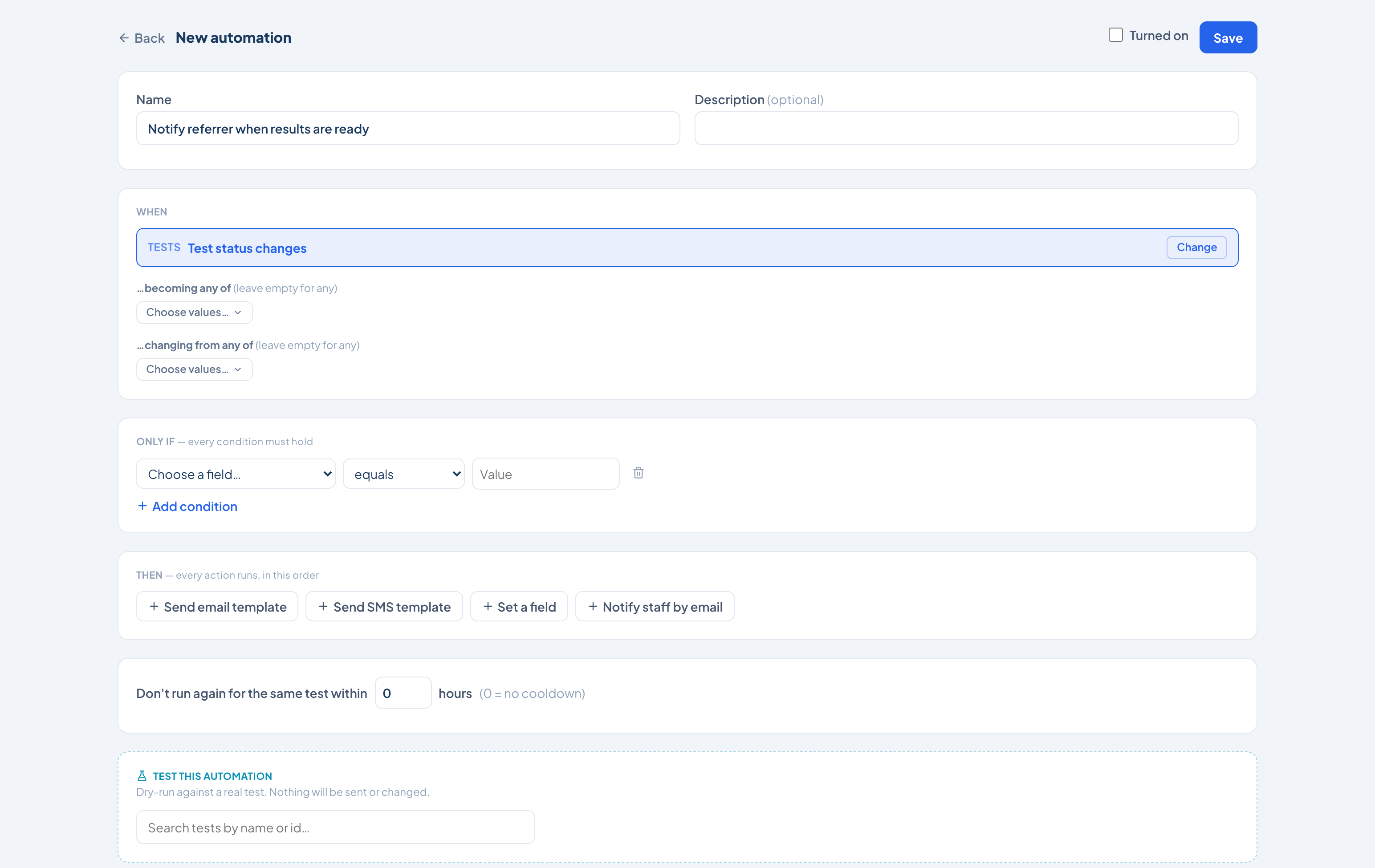
Workflows practices actually run
When
Test status changes
- …becoming any of
- Awaiting feedback
- …changing from any of
- In progress
Only if — every condition must hold
Referring Doctoris not emptyClinical Serviceis one ofCardiology, Sleep
Then — every action runs, in this order
- 1Send email template“Results ready” to the referring doctorimmediately
- 2Set a fieldPriority → Highimmediately
- 3Notify staff by emailthe reporting queueimmediately
67 events can start a workflow
Clinical, financial, administrative and inventory — the whole platform, not just the patient record.
Tests9
Test status changes
Patients6
Patient status changes
Calendar4
Calendar event status changes
Invoices7
Invoice is created
Payments3
Payment is received
Clinical Services4
Service is created
Leads5
Lead is created
Reports4
Test report is confirmed
Letters2
Letter is signed
Tasks4
Task is created
Inventory4
Inventory item is created
Delivery Notes3
Delivery note is created
Loss & Adjustments4
Loss or adjustment is created
Purchase4
Purchase order is created
Notes1
Note is created
Form Results2
Form is submitted
Custom Buttons1
Custom button is pressed
What it can do
Send an email template
Your branded template, to the patient, the referrer or anyone on the record — immediately or after a delay you set.
Send an SMS template
The same, over SMS, for the messages that have to be read rather than filed.
Set a field
Any field on the record — status, priority, assignee, dates, insurer, device, and every custom field your practice has added.
Notify staff by email
Put the right person on it the moment the condition is met, without them watching a queue.
Condition operators
Built to be trusted with live work
An automation that fires on a patient record has to be safe to change. These are the guardrails around every workflow.
- Transition matching, not just state
- A trigger can watch what a field is becoming and what it is changing from — so "moved out of Awaiting results" is a rule, not a report.
- Ordered actions with delays
- Actions run in the order you place them, each either immediately or after a wait you set in minutes.
- Cooldowns
- Stop a rule firing twice for the same record inside a window you choose — no duplicate reminders when a status bounces.
- Dry run before you arm it
- Test the automation against a real record. It reports what would happen and sends nothing, changes nothing.
- Versioned and reversible
- Every save is a new version. Turn a workflow off, roll it back, or export it and import it into another site.
- Run history you can audit
- Every execution is logged against the record it touched, with the outcome — completed, skipped or cancelled — and why.
Connect the systems you already rely on
MedOS sits across your existing healthcare environment — connecting legacy systems, practice software, billing providers, hospital systems, GP vendors, forms, documents and external platforms into one operational layer.

Clinical & standards
- HL7 interfaces
- FHIR resources
- GP & hospital systems
- Pathology & imaging
Billing & claims
- Medicare
- Health funds
- Payment gateways
- Reconciliation
Communications
- SMS
- eFax
- Workflow templates
Documents & AI
- PDF referrals
- Scanned documents
- AI / OCR extraction
- Document repositories
MedOS doesn't need to replace everything. It helps everything work better together.
Build workflows without waiting for complex IT projects
MedOS supports low-code and no-code configuration so healthcare teams can adapt quickly. Forms, templates, automations, workflows and modules configure around real operational needs.
Built for healthcare-grade operations
Healthcare operations require strong privacy, security and accountability. MedOS is built with secure access, controlled permissions, auditability and responsible data handling.
Secure user access
Authenticated sign-in for every user.
Role-based permissions
Right people, right data — nothing more.
Audit trails
Every action traceable and accountable.
Encrypted data handling
Responsible, encrypted data handling.
Controlled document access
Documents reach only the right people.
Secure forms
Patient information captured safely.
Structured workflows
Consistent, governed processes.
Compliance-aware config
Configurable to your compliance needs.
Secure integrations
Protected connections to external systems.
Ready to make healthcare run better?
MedOS helps healthcare organisations connect fragmented operations, reduce manual admin, improve visibility and deliver a smoother patient journey.